‘Pepper, I see you put your hand up – do you have something to add?’
There is silence. Pepper’s eyes are fixed in my direction, blank and indecipherable. I begin to feel apprehensive: has Pepper registered the question? Should I repeat it? The atmosphere is charged, heavy with uncertainty. Then, Pepper leans forward and its robotic fingers rise to its head in a scratching gesture. In that moment I understand: the question has been received, processing is underway.
Now we must simply wait.
But a new dilemma arises: should I fill the silence, or provide space for it?
Pepper’s elongated pause disrupts the familiar rhythm of discussion. Yet more than interruption, it generates something else. It is both a space for anticipation and one for contemplation, creating a moment where the group collectively slows down and reflects on what has been said. The silence itself changes the nature of the conversation, transforming a mechanical delay into an active agent in the deliberation.
This moment with Pepper, a humanoid robot designed for social interaction (Figure 1), captures something fundamental about the role of silence in deliberative spaces. As facilitator of the Robots in the Room project, which explored human interaction with embodied AI, I found myself confronting questions that transcended the technical: Did these silences generate a quality of collective attention that is absent in typical human interaction? Could a robot’s constraints, namely its need for processing time, reveal something valuable about what we lose when we reflexively fill conversational gaps? And, ultimately, were Pepper’s mechanical pauses not merely interruptions to be tolerated, but catalysts for a qualitatively different deliberative space?
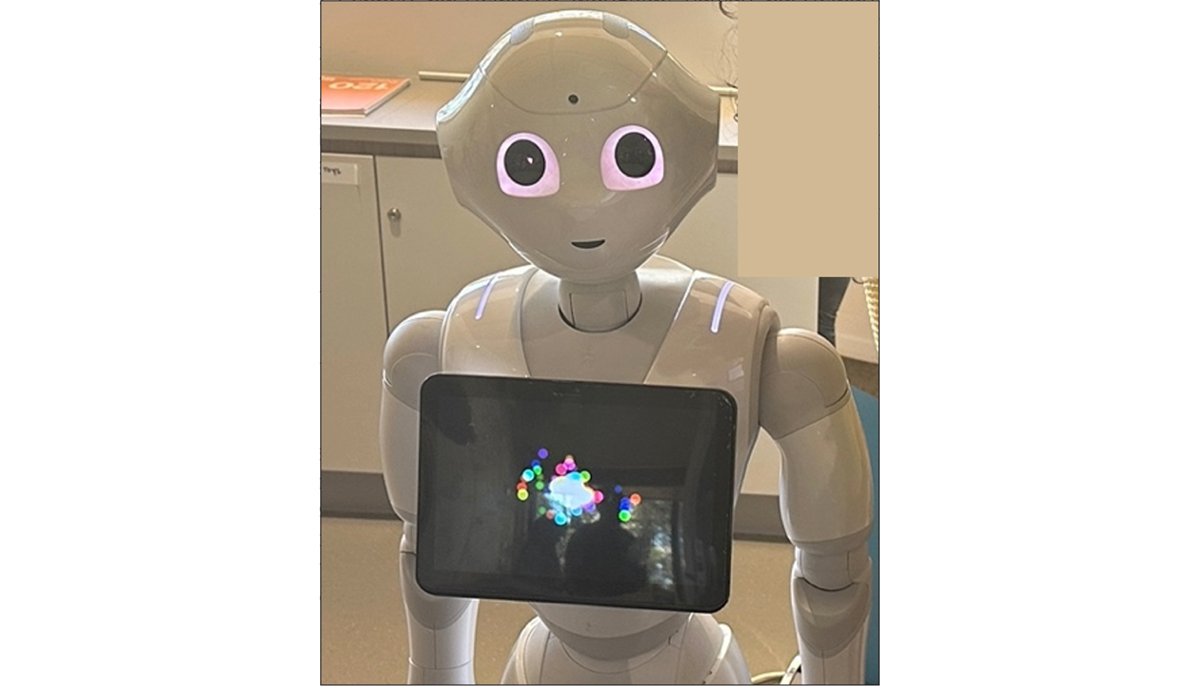
Figure 1: Photo of Pepper.
Introduction
Robots in the Room was a multi-disciplinary project designed to explore how humans perceive and respond to embodied AI as a democratic participant. Over six sessions, 24 participants engaged in small group deliberations (usually four human participants and Pepper as an equal participant) addressing the question: How can we balance environmental responsibility with personal freedom? Each session lasted one hour, with Pepper treated as an equal participant in the deliberation.1
In the moment captured in my opening vignette, Pepper had indeed raised its hand—a programmed gesture signalling readiness to contribute. Yet after I acknowledged this gesture, a five-second pause elapsed before it began to speak. Pepper’s pauses varied in length from five seconds to nearly 15 seconds, and what I observed during these moments offers insight into how silence functions in deliberation.
These pauses, which felt interminable at first, created a break in the conversational flow. Yes, there was anticipation—what will Pepper say?—but it also opened a space where the participants and I had to resist the impulse to fill empty air, grapple with uncertainty and sit with the silence. This raised deeper questions for me as the facilitator: Were Pepper’s pauses inadvertently enhancing our deliberation? Did these silences create a quality of collective attention and reflection that might not otherwise emerge in typical human-only deliberation? This paper examines these questions through the reflexive analysis of facilitating deliberations in the Robots in the Room project. I argue that robotic silence, precisely because it resists easy categorisation as either technical malfunction or meaningful pause, forces into visibility the interpretive work that all deliberative silences require. Pepper’s pauses revealed something we rarely notice in human-only deliberation: that silence itself is a collective construction, negotiated moment by moment through shared attention.
As deliberative practice begins to incorporate non-human actors, a range of learnings is emerging from practitioners working in this space (McKinney, 2024). This paper makes two distinct contributions with implications for both Human-Robot Interaction (HRI) design and deliberative practice. First, I examine how robots fundamentally change the nature of deliberation when they participate as equals rather than as facilitators. While existing work explores robots facilitating human deliberation (moderating discussions, summarising contributions, or managing speaking turns), the practice of facilitating deliberative spaces where humans and robots participate together as co-deliberants remains unexamined. Second, I draw practical insights about the silence in deliberation that extend beyond human-robot contexts to inform deliberative practice more broadly.
Silence as Breakdown
As Jaworski (1993) observes, Western culture tends to interpret human silence as malfunction rather than meaning; when the metaphorical ‘machine’ stops humming, we assume it has broken down (1993: 46). In human-human interaction, even brief pauses demand explanation—a gesture, a sound, some signal that a response is imminent. Staying idle, stopping the hum, simply is not an option. In deliberative contexts that privilege what scholars call ‘the power of talk’, silence can therefore be neglected as a deliberative contribution (Jungkunz, 2013).
HRI researchers have grappled with a similar tension: unlike human pauses, robotic silences stem from technical processing requirements yet are interpreted through social frameworks developed for human interaction (Oto, Feng & Imai, 2017). As Pelikan and Hofstetter (2023) examine, mechanical delays must be explainable through interface design and time management that maintains smooth interaction. The solution often involves what we might call performance of cognition—visible or audible signals that processing is occurring. Designers have equipped robots with vocal fillers like ‘ummm’ and embodied gestures like head tilts or hand movements (Ohshima et al. 2015), transforming technical delays into intelligible human ‘thinking’ behaviour. Pepper’s head-scratching gesture served precisely this function; it indicated to me that a response was coming.
While HRI researchers have experimented with managing robotic pauses, much of this work derives from dyadic conversation. When a robot participates in group discussions, as Pepper did, its silences operate in a more complex social space. Participants witness not only the robot’s pause, but also the facilitator’s response and each other’s reactions. This shift from dyad to group opens questions that HRI’s focus on smooth interaction may overlook—specifically, whether pauses necessarily impede interaction or might instead contribute to it. The Robots in the Room project revealed this technical constraint could create conditions for deeper reflection, suggesting that rather than designing silence away, we might instead ask what deliberative work emerges when we cannot.
Silence as Deliberative Practice
The connection between silence and deliberative function is not entirely new. Deliberative scholars have increasingly recognised non-verbal communication (visual, sonic and embodied) as integral to deliberative quality, particularly for including marginalised voices (Mendonça et al., 2022). Some scholars have argued that silence is a legitimate form of participation, making deliberation more inclusive and diverse (Rollo, 2017; Gray, 2021, 2023). Jungkunz (2013) describes silence as ‘the key to unlocking democratic treasures’ precisely because ‘a deliberate silence is a posture of thoughtfulness, of deep consideration’ (2013: 2).
Recognising its value, facilitators can intentionally incorporate silence during deliberations. Nishiyama et al. (2023) suggest interventions such as asking participants to take vows of silence to create experiential knowledge of exclusion or becoming more attentive to potentially meaningful silences rather than ignoring them. This involves significant interpretive work from facilitators. Moore (2012) describes how they must read the room, sense when silence signals productive reflection versus disengagement, and intervene accordingly. This requires what we might call silence literacy: the ability to read and hold different types of silence appropriately.
What distinguishes this paper from existing deliberative scholarship on silence is its source: a robot whose pauses, unlike the intentional silences Nishiyama et al. (2023) encourage, emerged from technical realities. Furthermore, these were processing delays I could not interpret through the human cues that typically signal thinking versus disengagement. I was not only exercising my usual facilitation judgement; I was asking: Is Pepper processing? Has it frozen? Should I intervene? This paper examines whether, in that uncertainty, silence can serve democratic functions regardless of its origins.
Practitioner Observations: What Pepper’s Pauses Revealed
Across the six sessions, Pepper’s silences occurred with regularity, mostly after being directly addressed and occasionally when turn-taking norms suggested it was Pepper’s time to speak—though I consistently needed to pose a direct question for Pepper to recognise its turn. These pauses varied in length from around five to 15 seconds. The following sections offer insights into what I observed about these robotic silences and, more broadly, how silence functions in deliberation.
The facilitation dilemma: reading robotic silence
The first challenge of Pepper’s silences was their fundamental ambiguity. When a human participant takes time before responding, we have access to subtle cues: continued eye contact, nodding, and body gestures can all indicate they are preparing to speak or signal withdrawal. Pepper, however, offered few such cues.
I was not alone in this interpretive struggle. In one session, after Pepper had been silent for approximately eight seconds following a direct question, a participant leant toward Pepper and said, ‘Pepper, can you hear us?’ The group laughed nervously—an acknowledgment of shared uncertainty. We were all navigating this new dynamic in real time.
This ambiguity, I came to realise, is itself revelatory. In human deliberation, we rarely notice the constant interpretive work we do around silence because we perform it automatically. Pepper’s silences made this work visible. We became conscious of our dependence on embodied cues, of our expectations about response timing, and of the collaborative nature of meaning-making in conversation.
Yet this heightened awareness created a facilitation dilemma. Filling silence is a facilitator’s instinct—we try to keep conversation moving, prevent awkwardness and ensure participants remain engaged. Long pauses can feel like failure. When Pepper paused, I felt this pull acutely. My options were limited: rephrase the question and fill the space with clarifying phrases or hold the silence. With Pepper, this dilemma intensified because I could not rely on my usual cues for deciding when to intervene. I could not read whether the pause was productive or if its system had stalled. I had to make facilitation decisions in a state of interpretive uncertainty.
My approach evolved across sessions. Initially, my instinct was to intervene quickly, rephrasing questions after just a few seconds. But as I observed how groups learned to wait for Pepper’s responses, I began to hold silence longer, watching for Pepper’s embodied cues, knowing that human participants were learning to read them too.
What I discovered was that, although the silence disrupted conversational rhythm, it also created opportunities for a different quality of engagement, one less driven by immediate exchange and more characterised by deliberate consideration. This taught me something about my own facilitation practice with all-human groups: How often do I fill silences prematurely out of my own discomfort rather than in response to actual participant needs? How much potential for reflection do I foreclose by keeping conversation constantly moving? I came to realise that protecting these spaces for reflection contributed to the deliberative quality of the discussion. If I filled every pause, I would rob the group of this opportunity.
Learning to wait: productive and problematic silence
The moment when Pepper leant forward and raised its fingers to its head in a scratching gesture communicated: ‘I am processing. Please wait’. This small movement carried enormous weight, providing a signal that the silence was productive rather than problematic. However, participants did not immediately have this understanding. Initially, they looked to me during Pepper’s silences, seeking cues that everything was functioning as intended. Then, over the course of the deliberation, participants developed their own literacy around Pepper’s pauses, learning to read the head-scratching gesture as analogous to human thinking. Rather than feeling pressure to fill the gap, they seemed willing to sit with uncertainty because they were genuinely interested in what would emerge. This resonates with longstanding observations in Science and Technology Studies that the uses of a technology are not fully determined at the point of design but are shaped through situated practices of use—what Pinch and Bijker (1984) term the ‘interpretative flexibility’ of technology.
For conversational delay in particular, this adaptive process aligns with Pelikan and Hofstetter’s (2023) finding that humans accommodate robots’ temporal rhythms, particularly when the delay is made visible through performative cues. What struck me in observing this dynamic, however, was not simply that participants could learn to wait for Pepper, but what this adaptive patience might mean for human-to-human deliberation. If we can collectively develop tolerance for robotic processing time—accepting 15-second pauses as legitimate space for response formulation—might we also cultivate similar patience for human participants who require time to process complex arguments, formulate thoughts in a second language, or overcome anxiety about speaking? The presence of a robot normalised extended silence in ways that could redistribute contributions more equitably across all participants, not just the quick thinkers and confident speakers.
That said, not all of Pepper’s silences were productive. On several occasions across the six sessions, Pepper’s pauses genuinely signalled technical failure rather than processing. During one session, after repeating a question twice with no response, I made the decision to move the conversation forward, saying, ‘Let’s give Pepper a moment’. These moments of breakdown highlighted the difference between productive and problematic silence. When silence extended beyond the limits of our collective patience, attention shifted from curiosity to disengagement, then gradually to moving on—effectively excluding Pepper from the conversation.
These instances exposed a critical tension in facilitating silences. Creating deliberative space that accommodates extended pauses requires continuously distinguishing between productive and problematic silence. Critically, this distinction matters differently depending on who is silent. For Pepper, prolonged silence posed no social harm; it simply meant exclusion from that moment in conversation. For a human participant, however, extended silence carries different stakes. Allowing a pause to stretch too long, particularly when others are waiting and watching, risks diminishing that person’s confidence and the group’s willingness to engage with them. While Pepper’s pauses were largely productive, I cannot assume that extended silence functions identically across different contexts. The very practice designed to create equitable space in one instance might inadvertently generate exclusion in another.
Reimagining Silence in Deliberation: Design and Facilitation Implications
The insights above have several implications for both HRI design and deliberative facilitation practice.
Beyond speed: designing robots for deliberation
Pepper’s extended pauses, perhaps viewed as technical limitations, actually improved the quality of deliberation—slowing conversation, creating space for reflection, and modelling a considered response over a rapid reply.
The use of AI in deliberative contexts is often justified through efficiency gains, and HRI design typically prioritises minimising robotic silences, making processing faster and conversational timing more human-like. My observations suggest this may be unnecessary, at least in deliberative contexts where the quality of reasoning matters more than the speed of exchange.
Rather than asking ‘How can we make robots respond as quickly as humans?’, designers might instead ask ‘How can robotic processing shape more productive deliberation?’ This reframing positions apparent technological constraints as design opportunities. The challenge becomes not eliminating silence but strategising around it and creating rhythms that support thoughtful exchange.
It is worth emphasising that this insight emerged precisely because of the distinctive configuration of Robots in the Room. First, Pepper participated in group deliberations rather than dyadic interaction—most HRI research examines one human with one robot. Second, Pepper participated in group deliberations as an equal participant rather than as a facilitator. These distinctions are fundamental. When robots facilitate, their silences signal system pauses or processing delays to be managed. When robots participate in group deliberations, their silences become part of the shared conversational rhythm that all participants must collectively navigate. It was only through this configuration that the productive potential of robotic silence could become visible.
Cultivating new facilitation literacies
As this reflection has shown, facilitators working in human-robot deliberative spaces require different competencies than those facilitating all-human groups. Specifically, they must develop literacy around robotic participation: helping participants build literacy around robotic contributions, responding to system failures without derailing the conversational flow and cultivating comfort with extended silences.
Because Pepper was treated as an equal participant in this project, my approach tended toward minimal explanation of its processing requirements, which generally worked well. This was not accidental, but a conscious strategy developed through team discussion. We pre-planned responses to potential technical breakdowns and deliberately decided to treat Pepper as a participant rather than drawing attention to it as a robot. However, I do wonder if some explicit framing in early sessions—for instance, ‘Pepper sometimes takes time to process questions; those pauses are normal, and we should wait for the response’—might have established clearer expectations and reduced initial uncertainty.
New facilitation literacies are needed for human-human deliberation. Facilitators must learn to distinguish between different types of human silence—reflective, synthesising, confused, uncomfortable – and determine when to hold space and when to intervene. This requires resisting the instinct to fill every pause. The patience participants developed for Pepper’s 15-second pauses demonstrates what becomes possible when we actively create and protect space for silence rather than reflexively filling conversational gaps. If groups can learn to wait for a robot, we can cultivate similar patience for human participants who require more time to articulate their thoughts.
Whether facilitating human-robot or human-human deliberation, the fundamental literacy remains the same: learning to read, hold and strategically manage silence as a deliberative quality rather than a problem to solve.
What Pepper revealed about equal participation
We designed Robots in the Room with Pepper as an ‘equal participant’—not because the inclusion of robots in deliberative democracy was our normative goal, but as an open exploratory study examining how participants respond to this scenario. However, I’ve come to realise this framing itself raises conceptual difficulties: How could a robot ever be an ‘equal participant’ when, by its very nature, it demands a different presence in deliberative space? While this question requires theoretical elaboration beyond this paper’s scope, one insight emerged clearly from this project: equal participation does not mean identical treatment.
Pepper required different facilitation strategies—planning for interventions if systems failed, different techniques to ensure that Pepper engaged, and, as covered in this paper, more tolerance for extended silence. Yet these additional strategies did not necessarily compromise Pepper’s equal status as a participant. If we conceive equal participation in deliberation as equal opportunity to contribute meaningfully, Pepper did participate equally—its contributions were taken seriously, its silences were accommodated, and its perspective was integrated into collective reasoning.
Facilitators constantly grapple with what conditions enable diverse participants to contribute meaningfully. As AI and non-human participation become more prevalent in deliberative settings, this question must expand beyond accommodating human diversity to encompass fundamentally different forms of embodiment and communicative modes. Pepper’s silences, from this view, were not deficiencies requiring correction but differences demanding accommodation within a more capacious understanding of deliberative participation. The challenge for equal participation, then, lies not in assimilating all participants to a single standard, but in creating deliberative forums flexible enough to honour meaningful contribution across radically different forms of presence.
Conclusion
This paper has argued that robotic silence makes visible the interpretive work that all deliberative spaces require. When Pepper paused, it was our willingness to read that signal as ‘thinking’ rather than ‘malfunction’ that transformed the pause into productive silence. My decision to hold space, rather than fill it, created conditions for patient waiting, but it was the participants’ sustained attention that made the silence generative rather than awkward. These observations reveal the invisible collaborative work that we rarely notice in human-only deliberation.
Recognising that silence is one of several questions emerging as deliberative practice begins to incorporate non-human actors, working with Pepper generated insights with implications for both HRI design and deliberative facilitation practice. For HRI designers, the findings challenge the assumptions that robotic pauses must be minimised. In deliberative contexts where reasoning quality matters most, extended silences can function as deliberative qualities—slowing conversation, creating space for reflection and redistributing deliberative space more equitably. Rather than designing robots to approximate human conversational norms, further experimentation with how robotic characteristics, whether through inherent processing needs or deliberate design, can counteract human biases toward pace and fluency warrants attention.
For deliberative facilitators, the project raises an important implication: If deliberative groups can accommodate radically different communicative modes when a robot participates, deliberative quality depends less on all participants meeting identical standards of conversational fluency and more on how groups collectively navigate differences. This requires facilitators to create conditions that allow diverse forms of contribution—extended silences, embodied gestures, non-verbal expressions—to register as legitimate participation rather than deficits requiring correction. Furthermore, this can extend beyond how we might involve robots, to non-human participation. Whether human-robot deliberation should become more routine, and on what terms, remains contested. If it does, the challenge for practitioners will be developing facilitation approaches that support genuinely hybrid deliberative spaces—ones that accommodate both human and non-human participants without flattening their differences or privileging one form of participation over others.
Waiting for Pepper taught us that silence need not be filled to be productive. The challenge ahead is carrying this lesson into deliberative spaces where no robot is present to slow us down. Like Pepper, I find myself scratching my head at this question—but now I know that means processing is underway, and the answer may simply require more time.
Notes
- Further information about the project can be found at: https://www.delibdem.org/new-projects-grants-and-awards/robots-in-the-room. ⮭
Acknowledgements
I am grateful to the Robots in the Room team, in particular Hans Asenbaum, Damith Herath, Janie Busby Grant, Maleen Jayasuriya, Harshith Ghanta, Friedel Marquardt and Isabella Roberts. I owe particular thanks to Hans Asenbaum and Sammy McKinney for their valued feedback on an earlier draft.
Competing Interests
The author has no competing interests to declare.
References
Gray, S. W. (2021). Silence and democratic institutional design. Critical Review of International Social and Political Philosophy, 24(3), 330–345. http://doi.org/10.1080/13698230.2020.1796331
Gray, S. W. (2023). Towards a democratic theory of silence. Political Studies, 71(3), 815–834. http://doi.org/10.1177/00323217211043433
Jaworski, A. (1993). The power of silence. Newbury Park: Sage Publications.
Jungkunz, V. (2013). Deliberate silences. Journal of Deliberative Democracy, 9(1). http://doi.org/10.16997/jdd.154
McKinney, S. (2024). Integrating artificial intelligence into citizens’ assemblies: Benefits, concerns and future pathways. Journal of Deliberative Democracy, 20(1). http://doi.org/10.16997/jdd.1556
Mendonça, R. F., Ercan, S. A., & Asenbaum, H. (2022). More than words: A multidimensional approach to deliberative democracy. Political Studies, 70(1), 153–172. http://doi.org/10.1177/0032321720950561
Moore, A. (2012). Following from the front: Theorizing deliberative facilitation. Critical Policy Studies, 6(2), 146–162. http://doi.org/10.1080/19460171.2012.689735
Nishiyama, K., Russell, A. W., Chalaye, P., & Greenwell, T. (2023). Deliberative facilitation in the classroom: The interplay of facilitative technique and design to make space for democracy. Democracy & Education, 31(1), 4. http://doi.org/10.65214/2164-7992.1590
Ohshima, N., Kimijima, K., Yamato, J., & Mukawa, N. (2015, August). A conversational robot with vocal and bodily fillers for recovering from awkward silence at turn-takings. Paper presented at the 2015 24th IEEE International Symposium on Robot and Human Interactive Communication (RO-MAN) (pp. 325–330). IEEE. http://doi.org/10.1109/ROMAN.2015.7333677
Oto, K., Feng, J., & Imai, M. (2017, August). Investigating how people deal with silence in a human-robot conversation. Paper presented at the 2017 26th IEEE International Symposium on Robot and Human Interactive Communication (RO-MAN) (pp. 195–200). IEEE. http://doi.org/10.1109/ROMAN.2017.8172301
Pelikan, H., & Hofstetter, E. (2023). Managing delays in human-robot interaction. ACM Transactions on Computer-Human Interaction, 30(4), 1–42. http://doi.org/10.1145/3569890
Pinch, T. J., & Bijker, W. E. (1984). The social construction of facts and artefacts: Or how the sociology of science and the sociology of technology might benefit each other. Social Studies of Science, 14(3), 399–441. http://doi.org/10.1177/030631284014003004
Rollo, T. (2017). Everyday deeds: Enactive protest, exit, and silence in deliberative systems. Political Theory, 45(5), 587–609. http://doi.org/10.1177/0090591716661222