Introduction
Public health emergencies such as the COVID-19 pandemic exacerbate health inequities, disproportionately affecting minority and low-income populations (Armstrong et al. 2007; Bollyky et al. 2023). During the pandemic in the United States, these communities faced heightened challenges due to job losses, greater exposure to infection, and worse health outcomes, which in turn led to severe economic consequences such as bankruptcy, housing instability, educational losses for children, and food insecurity (Tan et al. 2020). Black and Latino workers, for example, experienced higher unemployment rates than White individuals; minority renters reported greater difficulty paying rent or mortgages; and students from disadvantaged backgrounds had less access to in-person learning and reliable internet connectivity (Tai et al. 2022). Low-income families also faced greater barriers to essential services such as affordable childcare, nutrition, and healthcare. These compounded disadvantages illustrate how the pandemic both revealed and intensified existing inequities in the United States (Adhikari, Cheah & von Seidlein 2022).
US governmental programs provided temporary relief during the COVID-19 crisis. Despite high rates of unemployment during the pandemic, child poverty, as measured by the Supplemental Poverty Measure, declined by 25% in 2020 and by nearly 50% in 2021 to 5.2% (US Census Bureau 2025). In 2022, with the expiration of the expanded Child Tax Credit, expanded SNAP eligibility, and other programs, child poverty increased to 12.4% (Smith 2020). Disparities in health, education, housing, and food security have persisted among low-income communities in the United States. Addressing these disparities requires long-term structural changes (Office of Disease Prevention and Health Promotion 2024). Limited resources, however, necessitate difficult policy choices and tradeoffs between competing needs. Involving those most affected by these policies can make those tradeoffs more just, fair, and responsive to community needs (DeGrazia & Millum 2021; Fleck 1991; Goold 1996; Soled 2021).
To engage underserved and low-income communities in developing policy options, traditional methods, such as polling or focus groups, can capture individual opinions on familiar topics (Cargill, Baker & Goold 2017). However, the complexity of government spending programs and the need to learn from others’ experiences may necessitate a more in-depth approach to soliciting opinions that include learning, consideration of diverse perspectives, and the formation of collective judgments in addition to individual opinions.
Deliberative methods of community engagement offer a promising solution to the challenge of public participation in complex policy decisions (Blacksher et al. 2012; Fishkin 1995). These methods involve gathering diverse groups of lay citizens to learn about and discuss complex topics, engage in in-depth reasoning, consider diverse perspectives, and form policy recommendations (Cohen 1997). Deliberative approaches are intended to create a more informed public, enhance decision legitimacy, and support more reflective public input into policy choices (Blacksher et al. 2022). In contrast to traditional dialogue or focus groups, deliberative methods emphasize learning about a policy issue, giving reasons for opinions, and engaging in collective decision-making (Abelson et al. 2003). This requires that deliberators be open to hearing and respecting other points of view and, in some cases, reconsidering their own opinions.
Recent evidence indicates that online deliberation can reproduce many of the benefits of in-person dialogue, including respectful exchange, increased political knowledge, and openness to diverse perspectives while also facing challenges related to digital access, digital literacy, and the loss of some non-verbal cues (Janssen & Kies 2005; Min 2007; Strandberg & Grönlund 2018). These barriers may be particularly problematic for marginalized groups (Følstad & Lüders 2013; Min 2007).
Several prior studies have used the CHAT (Choosing All Together) tool to engage low-income individuals in deliberations about health care priorities, showing that structured group exercises can enhance understanding of tradeoffs, encourage reflection on community needs, and support collaborative decision-making (Danis et al. 2007; Ginsburg, Goold & Danis 2017; Goold et al. 2004). The present study builds on this work by examining post-pandemic social programs in a virtual setting, assessing changes in individual preferences and openness to diverse perspectives.
Empirical research on deliberation shows that deliberative processes can increase political knowledge, mutual respect, willingness to listen to opposing views, and tolerance of disagreement (Abelson et al. 2003; Fishkin 1995); however, evidence that deliberation produces substantive or directional policy preference change is more mixed (Bächtiger et al. 2020; Blacksher et al. 2012; Curato et al. 2017). Some deliberative studies find that participants revise policy opinions after receiving balanced information and discussing issues with others, but these changes vary by issue, context, baseline attitudes, and the salience or moral weight of the topic (Gastil 2018; Grönlund, Bächtiger & Setälä 2014; Wojcieszak & Price 2010). On complex distributive issues, such as government spending and social benefits, deliberation may clarify values or increase understanding of tradeoffs without necessarily moving participants toward a particular policy position (Minozzi 2012). Thus, deliberation may produce reflecting stability, attitude clarification, or greater openness to disagreement rather than consensus or directional policy change.
This distinction is particularly important for deliberation about social assistance programs. Decisions about government benefits involve competing commitments to need, fairness, fiscal constraint, individual responsibility, and collective obligation. Participants may become more willing to hear opposing views or more comfortable discussing these tradeoffs while still remaining committed to their initial policy preferences. Increases in openness to dialogue therefore should not be assumed to translate into changes in support for expanding or reducing social benefits. This distinction provides the basis for examining both substantive policy preferences and intermediate deliberative outcomes, such as openness, receptiveness to opposing views, and willingness to engage in respectful dialogue.
Therefore, this study examines whether virtual deliberation among low-income adults about post-pandemic social programs was associated with changes in policy preferences, openness to discussion, receptiveness to others’ perspectives, and willingness to engage in respectful dialogue. We also use qualitative analysis of deliberative discussions to explore how participants reasoned about government assistance programs, and what factors may have contributed to changes or stability of their views.
Methods
Population and sampling
Low-income English- and Spanish-speaking adults, defined as adults living in households below 300% of the federal poverty level (FPL), were recruited. This threshold was selected to align with commonly used eligibility criteria in US health and social service programs to capture individuals who, while not meeting strict poverty definitions, nevertheless experience financial strain and barriers to healthcare access (HHS: Affairs (ASPA) 2025; ‘Primer: CHIP’ 2017). We recruited participants using a University of Michigan online site for research volunteers, flyers, Facebook advertising, newsletters, newspapers, and communications distributed by community partners through their networks (https://umhealthresearch.org/ 2025). Because we had difficulty recruiting participants in Michigan who preferred the Spanish-language deliberations, we expanded our recruitment to include Colorado and Ohio. Potential participants completed a screening questionnaire in English or Spanish that asked about age, race, ethnicity, household income and size, and access to internet and devices. We aimed for a sample that was one-third Black American, one-third Latina/o, and at least 10% rural.
Participants were not randomly assigned to deliberation sessions. Instead, the 126 participants were placed into one of the 26 sessions (English: 21, Spanish: 5) based on recruitment timing, scheduling availability, and preferred language of participation. Latino participants were assigned to English- or Spanish-language sessions based on their preference. Sessions included three to nine participants. Because group composition was determined by practical and linguistic considerations rather than random allocation, the findings should be interpreted as descriptive and associational rather than causal.
CHAT: deliberative democracy tool
CHAT is a deliberative democracy tool designed to facilitate structured group discussion about resource allocation under constraints (Goold et al. 2005; Perry et al. 2025); CHAT aims to promote reasoned dialogue about complex and value-laden allocation decisions among ordinary persons in a respectful, informative, and engaging manner (Burkhalter, Gastil & Kelshaw 2002). Research has demonstrated that participation in CHAT influences individuals’ understanding and opinions about health-related priority setting and can stimulate public dialogue about limited health care resources (Danis, Ginsburg & Goold 2010; Goold et al. 2005).
CHAT presents participants (deliberators) with a game board that resembles a pie chart. Each wedge of the circle represents a category of spending (see Figure 1). Within each category, different amounts of spending are represented by different levels within each wedge; there is also an option to spend no markers on the category. Participants select the level of funding for each category by allocating the number of markers required for the level they choose. However, the number of markers available to participants does not allow them to select the highest level of spending for every category. Thus, allocation decisions involve tradeoffs; choosing high spending in one category requires lower or no spending in another.
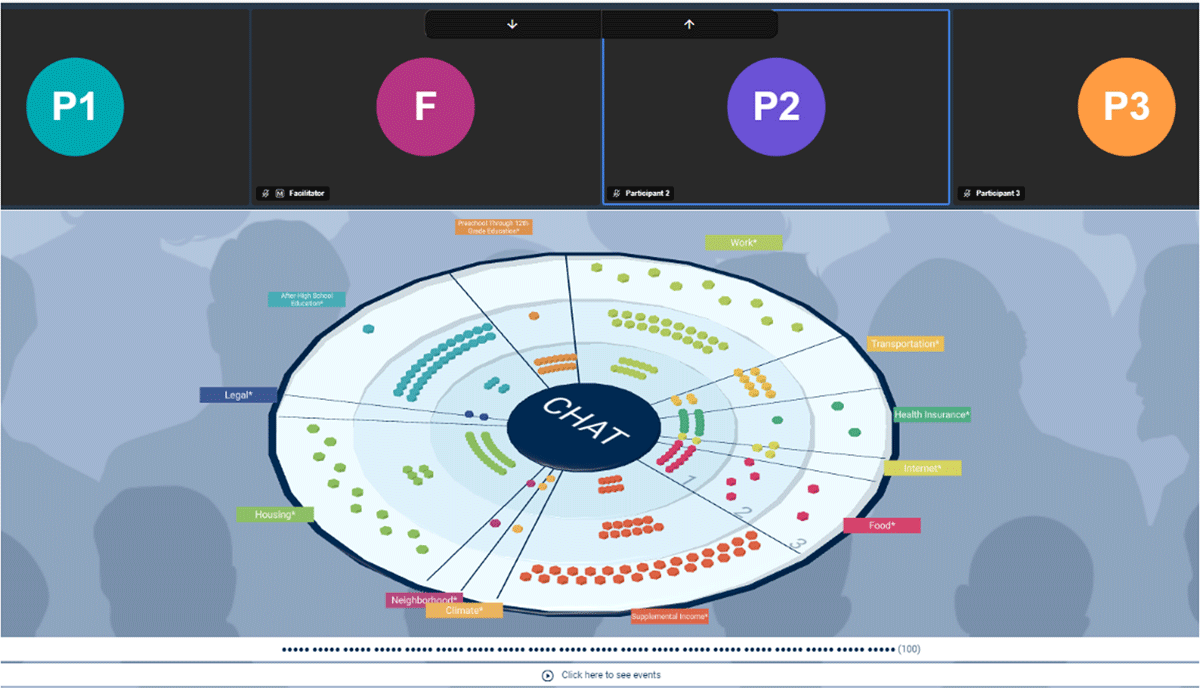
Screen picture of CHAT board on website.
The costs and benefits offered at each level were chosen to reflect actual costs and benefits; thus, the cost–benefit tradeoffs faced by CHAT participants were designed to approximate those faced by policymakers. The costs for each level within each category were estimated through a combination of publicly available data sources and consultation with experienced actuaries and actuarial science students from Central Washington University. We developed 12 categories that captured current and potential areas of government spending (see Appendix). Within each category, we aimed to have one level of spending reflecting current spending, and, when feasible, levels that reflected both more and less spending in those areas.
Levels that represented increased or decreased spending were designed in cooperation with the DECIDERS Steering Committee, a long-standing committee established to represent minority and underserved communities in Michigan that has existed for over a decade (Goold et al. 2016). This ensured realistic policy options that addressed the needs of affected communities. Members of the steering committee contributed their experiences to inform the development of the CHAT categories and spending options. They also supported recruitment by connecting the research team with community organizations and potential participants.
Figure description: The top bar is the videoconferencing section, which includes names and faces of all participants and facilitators. The videoconferencing bar can be made smaller using the arrow buttons at top, thus enlarging the screen size of the CHAT board. The CHAT board can also be moved, angled, and can be zoomed larger or smaller. Below the CHAT board is a horizontal bar with 100 markers – the budget – which automatically decreases as participants “spend” the markers on categories
Quantitative data collection and analysis
The pre-survey was typically completed one week before the deliberation, and the post-survey immediately after or within eight hours after the deliberation. Participants completed the same set of items in both the pre- and the post-deliberation questionnaires, regardless of whether their initial response favored or opposed increased government assistance. This ensures comparability across time points.
The questionnaire included the following questions regarding government assistance in general:
When considering the assistance that the government provides to people in need, I think the government: ‘Should provide more assistance’ OR ‘Is providing about the right amount of assistance’, OR ‘Should provide less assistance’.
In addition to asking about government assistance in general, we asked them to choose one of each of the following pairs of statements ‘even if neither is exactly right’. All four of these paired items present tradeoffs rather than true conceptual opposites, reflecting the complex nature of the underlying dimensions. These items were designed to capture competing perspectives and tradeoffs that frequently emerge in public discussions about government assistance spending (Barisione 2012; Spang 2021):
‘Government is almost always wasteful and inefficient’ OR ‘Government often does a better job than people give it credit for’.
‘Poor people today have it easy because they can get government benefits without doing anything in return’ OR ‘Poor people have hard lives because government benefits don’t go far enough to help them live decently’.
‘Government is doing too many things better left to businesses and individuals’ OR ‘Government should do more to solve problems’.
‘The government today can’t afford to do much more to help those in need’ OR ‘the government should do more to help those in need, even if it means going deeper into debt’.
Open mindedness
We employed two methods to measure openness to opposing views. First, we classified respondents based on their response to the assertion that ‘government can’t afford to do much more to help those in need’ and ‘government should do more to help those in need’. To assess openness toward opposing perspectives, participants rated their agreement with statements assessing willingness to hear, respect, and engage with people holding different views on government assistance. This approach aligns with research on affective polarization and cross-cutting political discussion (Druckman et al. 2021; Mason 2018). Those who chose the ‘government today can’t afford …’ statement were asked their level of agreement with the following statements:
➢ ‘Reasonable people could think the government today: Should do more to help those in need’.
➢ ‘If someone said to me that the government today should do more to help those in need, I would be willing to hear them out’.
➢ ‘I respect people who think the government today should do more to help those in need’.
While those who chose ‘government should do more …’ were asked their level of agreement with the following statements:
➢ ‘Reasonable people could think the government today can’t afford to do much more to help those in need’.
➢ ‘If someone said to me that the government today can’t afford to do much more to help those in need, I would be willing to hear them out’.
➢ ‘I respect people who think the government today can’t afford to do much more to help those in need’.
Second, we used three items to measure general willingness to discuss government assistance with people who have different views:
‘I would be willing to discuss the issue of government assistance with people who hold very different views from me’.
‘I would be comfortable expressing my true beliefs on government assistance to people with very different views’.
‘I might change my mind about government assistance after hearing what others think about the issue’.
To compare pre- and post-deliberation responses for the three general openness items, we used paired t-tests. The categorical item about whether government should provide more, less, or about the right amount of assistance was reported descriptively as n (%) because it was a three-category categorical measure with sparse cells.
To address non-random allocation to deliberation sessions, we conducted an additional session-level paired analysis. For each of the three openness outcomes, we calculated the mean pre-deliberation and post-deliberation score with each of the 26 deliberation sessions. We then calculated session-level change scores, defined as post-deliberation mean minus pre-deliberation mean, and tested whether the average session-level change differed from zero using one-sample t-tests, treating sessions as the unit of analysis. We also summarized the number of sessions with positive, negative, or no mean change for each outcome. These analyses were intended to assess whether observed changes were broadly consistent across deliberation groups; they do not establish causal effects.
CHAT: group exercise?
From October 2022 through August 2023, we conducted online deliberations with 21 English and 5 Spanish-language groups, with each group ranging from three to nine participants (total N = 126). All groups met virtually and participated in a version of CHAT (Goold et al. 2005) adapted for videoconference mode. Sessions led by trained facilitators lasted two to three hours. During the sessions, participants first selected the categories they considered most important. Participants then received ‘events’-briefly hypothetical scenarios showing the potential consequences, costs, and tradeoffs associated with the spending choices they made across program categories (e.g., education, legal service, and health). These scenarios reflected the implications of selecting different levels of investments within each category and were discussed with the group. The groups then deliberated to prioritize programs for low-income residents. Individuals then again selected priorities themselves. Priorities chosen by individuals and groups were recorded automatically by CHAT software. During the deliberations, participants had the option to remain anonymous to one another by using pseudonyms, though most of them chose to identify themselves by their names. This flexibility was intended to support participant comfort while maintaining structured deliberation (Burkhalter, Gastil & Kelshaw 2002; Goold et al. 2005).
Qualitative data collection and analysis
In the following section, we reported the qualitative methods according to the Consolidated criteria for reporting qualitative research (COREQ) (Tong, Sainsbury & Craig 2007).
Session transcripts were transcribed verbatim in English (with Spanish transcripts professionally translated and spot-checked by bilingual researchers). Four researchers conducted thematic analysis using an iterative process informed by prior CHAT deliberation studies (Cargill, Baker, & Goold 2017; Danis et al. 2010; Danis, Ginsburg & Goold 2010; Goold et al. 2005, 2018).
The researchers began by independently reviewing three transcripts to identify preliminary themes, and then met to develop a codebook with code definitions, inclusion/exclusion criteria, and illustrative examples (Carey, Morgan & Oxtoby 1996; Goold et al. 2018; Goold & Klipp 2002). The codebook was iteratively refined through pilot coding and regular team meetings. All transcripts were double-coded independently by the research team, and discrepancies were resolved through discussion until consensus was reached. Because our analytic approach used consensus coding within a team-based interpretive framework, we did not compute a formal intercoder reliability statistic; instead, we supported rigor through a transparent codebook, systematic documentation of coding decisions, and iterative refinement. Final themes were presented to the DECIDERS Steering Committee for feedback and interpretation.
Mixed-methods interpretation of findings
A convergent mixed-methods design (Fetters, Curry & Creswell 2013) was chosen for this study given that the qualitative and quantitative data were analyzed separately and then merged to explore low-income adults’ willingness to change their mind about government assistance after community virtual deliberations with others. Quantitative analyses examined changes in willingness to consider alternative views, and qualitative analyses provided context for understanding participants’ experiences and perspectives during deliberation. To protect anonymity, participants were identified by ID numbers in survey response and transcript, with no personal identifying information included in analytic datasets.
The National Institutes of Health and University of Michigan Institutional Review Boards both determined that the project was exempt from IRB review, as it met the federal criteria for exemption Category (2): research that only includes interactions involving educational tests (cognitive, diagnostic, aptitude, achievement), survey procedures, interview procedures, or observation of public behavior (§45 CFR 46.104(d)(2)).
Results
Quantitative findings
Sociodemographic characteristics
Twenty-one virtual CHAT sessions in English and five in Spanish included 126 low-income persons diverse in age, household size, urbanicity, and race/ethnicity (Table 1). The demographic breakdown of the sample is detailed in Table 1. The majority of participants were female (70.6%). The mean age of participants was 38.3 years. When asked to describe their race and ethnicity, 52.4% described themselves as White, followed by Black or African American (25.4%), around a third of participants identified as Hispanic (28.6%), which is slightly below the intended recruitment target of approximately one-third for each group, reflecting minor variation in realized enrollment.
Table 1: Sociodemographic characteristics (N = 126).
| 100% (126) | |
| Sex | |
| Male | 27.0% (34) |
| Female | 70.6% (89) |
| Other | 2.3% (3) |
| Age by range (mean 38.3 years) | |
| 20–35 years | 44.4% (56) |
| 36+ years | 55.6% (70) |
| Race/ethnicity (select all that apply)* | |
| White | 52.4% (66) |
| Black or African American | 25.4% (32) |
| Asian | 16.7% (21) |
| Other | 9.5% (12) |
| American Indian or Alaska Native | 7.8% (10) |
| Native Hawaiian or Pacific Islander | 0.8% (1) |
| MENA (Arab, Chaldean, Middle Eastern, or North African) | 2.4% (3) |
| Hispanic | 28.6% (36) |
| Non-Hispanic, Non-MENA White | 28.9% (37) |
| Households with children | |
| Households with children | 42.9% (55) |
| Households with children age 0–4 | 19.5% (25) |
| Households with children age 5–12 | 32.0% (41) |
| Households with children age 13–17 | 16.4% (21) |
| Educational attainment | |
| HS/GED or less | 6.3% (8) |
| Some college or 2-year degree | 31.0% (39) |
| 4-year degree or more | 62.7% (79) |
| Marital status | |
| Single | 46.0% (58) |
| Married or partnered | 41.8% (54) |
| Separated, divorced or widowed | 12.0% (15) |
| Health insurance | |
| Covered | 90.6% (116) |
| None/uninsured | 9.4 (10) |
| Health insurance type/source | |
| Job/union | 26.2% (33) |
| Insurance purchased by you or someone else | 15.9% (20) |
| Veteran/VA - Tricare/CHAMP—County | 0.0% (0) |
| Medicaid | 34.9% (44) |
| Medicare | 13.5% (17) |
| Student plan | 8.7% (11) |
| Other | 4.7% (6) |
| Respondent health | |
| Very good/ Excellent health | 40.5% (52) |
| Has one or more chronic health conditions | 51.6% (66) |
| COVID in self/family | |
| Ever tested positive for COVID | 57.8% (67) |
| Someone in household tested positive for COVID | 57.9% (73) |
| Someone in household sick with COVID | 23.6% (30) |
| Lost family member to COVID | 20.5% (26) |
| Was sick with COVID | 13.4% (17) |
| Rural resident (RUCA 4 or higher) | 10.9% (13) |
*Participants could select more than one race and ethnicity.
A high proportion of participants were from households with children (42.9%). Regarding education, 62.7% of participants had a four-year degree or higher. About equal proportions of participants were single (46.0%) or married/partnered (41.8%). Rural residents made up 10.9% of the sample.
All participants were below 300% of the FPL. Indicators of low-income status included participants’ health insurance coverage and safety net program use (Table 1). Overall, 34.9% had Medicaid, and 13.5% had Medicare, while 26.2% were covered by job/union insurance. Almost a tenth (9.4%) were uninsured, and 29.1% reported receiving food assistance during the pandemic (Table 2). Experience with government safety net programs varied but did increase for some types of assistance during the pandemic (food stamps, unemployment, student loan payment deferral, help with utilities, phone, and internet) (see Table 2). Low-income populations in the United States include higher proportions of women in certain subgroups (e.g., single-parent households) and are more likely to participate in safety net programs such as Medicaid and SNAP (Medicaid and CHIP Data Book 2023; Supplemental Nutrition Assistance Program (SNAP) 2024).
Table 2: Government assistance received by participants before and during the pandemic (N = 126).
| Received before pandemic 100% (126) | Received during pandemic 100% (126) | |
| Medicaid/state health insurance | 36.2% (46) | 31.5% (40) |
| Unemployment insurance | 4.7% (6) | 22.0% (28) |
| Housing/renters assistance | 3.1% (4) | 8.7% (11) |
| Help with utilities | 4.7% (6) | 12.6% (16) |
| Help with internet/phone bill | 3.9% (5) | 16.5% (21) |
| Food stamps/SNAP | 23.6% (30) | 29.1% (37) |
| Temporary Assistance for Needy Families (TANF) | 2.4% (3) | 0.8% (1) |
| Tuition assistance | 8.7% (11) | 5.5% (7) |
| Delaying student loan payments | 9.4% (12) | 15.7% (20) |
| Help paying for childcare/preschool | 1.6% (2) | 0.8% (1) |
| Job training/placement | 0% (0) | 2.4% (3) |
| Reduced public transit fare | 4.7% (6) | 2.4% (3) |
| Paid medical leave | 1.6% (2) | 1.6% (2) |
| Disability benefits/insurance | 13.4% (17) | 8.7% (11) |
| Other | 0% (0) | 1.6% (2) |
| None | 42.5% (54) | 32.3% (41) |
Abbreviation: SNAP: Supplemental Nutrition Assistance Program.
In terms of health status, 40.5% reported being in very good or excellent health, while 51.6% reported having one or more chronic health conditions. Regarding experiences during the pandemic, 57.8% of participants reported having tested positive for the virus, and one-fifth had lost a family member or friend to COVID-19. These measures are included as contextual indicators of participants’ lived experiences with health and pandemic-related social and economic disruptions, which may be relevant to perspective on government support programs. While this proportion may seem high, other research has found similar rates of bereavement overall, and higher rates for those from most minority groups (Riley 2024). Studies have also reported higher chances of experiencing the death of a close family member, and multiple such losses, among many minority groups and essential workers (Willis et al. 2025). We oversampled low-income and minority groups, communities disproportionately affected by COVID-19 mortality (COVID-19 CDC Weekly Updates 2023; Woolf et al. 2020). It is also possible that participants may have defined ‘family member’ broadly or that a recruitment reference to the pandemic may have drawn in those more directly affected. Overall, the elevated rate is consistent with the greater burden of COVID-19 in disadvantaged populations.
Openness to discussion and willingness to reconsider views about government assistance
Participants showed statistically significant increases in all three openness outcomes after deliberation (Table 3). Willingness to discuss government assistance with people holding different views increased from 3.14 before deliberation to 3.31 after deliberation. Comfort expressing one’s true beliefs to people with different views increased from 3.26 to 3.42. The largest change was observed for willingness to change one’s mind after hearing what others think, which increased from 1.95 to 2.72. Overall, these findings suggest that deliberation was associated with greater openness to dialogue, greater comfort expressing views across disagreement, and greater willingness to reconsider one’s views. To better understand the increase in willingness to reconsider views, we examined individual-level shifts. Overall, 55.6% of participants became more willing to reconsider their views after deliberation, 7.9% became less willing, and 36.5% did not change (Appendix: Supplementary Table S2). This pattern suggests that the overall increase in openness was driven primarily by participants who became more willing to reconsider their views after deliberation.
Table 3: Individual-level pre-post changes in the openness outcomes about government assistance (N = 126).
| Questions | Deliberation | Mean (SD) | Mean difference | p-value2 |
| I would be willing to discuss the issue of government assistance with people who hold very different views from me.1 | Before | 3.14 (1.03) | 0.17 | 0.047 |
| After | 3.31 (0.93) | |||
| I would be comfortable expressing my true beliefs on government assistance to people who hold very different views from mine.1 | Before | 3.26 (0.96) | 0.15 | 0.036 |
| After | 3.42 (0.86) | |||
| I might change my mind about government assistance after hearing what others think about the issue.1 | Before | 1.95 (1.13) | 0.77 | 0.001 |
| After | 2.72 (1.04) |
-
Note: Change scores (shown as mean difference) were calculated as post-deliberation minus pre-deliberation response. Positive values increased openness/willingness after deliberation. Session-level means were calculated for each of the 26 deliberation sessions.
Abbreviation: SD = standard deviation.
1Response scale: 0 = strongly disagree; 1 = somewhat disagree; 2 = neither agree or disagree; 3 = somewhat agree; 4 = strongly agree.
2Paired t-test. Pre- and post-survey.
General view about government assistance
Participants’ overall views about the level of government assistance remained largely stable (Table 4). Before deliberation, 79.4% of participants indicated that government should provide more assistance to people in need; after deliberation, this declined slightly to 74.6%. The proportion indicating that government provides about the right amount of assistance increased from 19.0% to 23.0%, while very few participants selected ‘should provide less assistance’ at either time point.
Table 4: General view of government assistance before and after deliberations (N = 126).
| Questions | Before n (%) | After n (%) |
| When considering the assistance that government provides to people in need, I think the government1 | ||
| Should provide less assistance | 2 (1.6) | 3 (2.4) |
| Is providing about the right amount of assistance | 24 (19) | 29 (23.0) |
| Should provide more assistance | 100 (79.8) | 94 (74.6) |
-
1Given the sparse distribution and small cell sizes, no inferential test is reported for this item.
Because this item was a three-category categorical measure and the ‘should provide less assistance’ category contained very few observations, we report this item descriptively rather than using mean differences or paired t-tests. These findings suggest that although openness-related outcomes increased, deliberation did not produce a meaningful increase in support for expanding government assistance.
Session-level sensitivity analysis
To assess whether pre-post changes were concentrated in particular deliberation groups, we conducted a session-level sensitivity analysis treating each of the 26 CHAT sessions as the unit of analysis (Table 5). For each session, we calculated the mean pre-deliberation and post-deliberation score and then calculated a session-level change score. The largest and most consistent change was observed for willingness to change one’s mind after hearing others’ views. The mean session-level change was 0.78, and 23 of 26 sessions showed positive change. Comfort expressing one’s true beliefs also increased at the session level, with a mean session-level change of 0.17 and positive change in 14 sessions. Willingness to discuss government assistance with people holding different views showed a positive mean session-level change of 0.16, although this did not reach statistical significance; 19 of 26 sessions showed positive change.
Table 5: Session-level sensitivity analysis of pre-post changes in openness outcomes across the 26 deliberation sessions.
| Outcome | Mean session level chance | 95% CI | Range of session-level changes | p-value2 | Positive sessions | No change | Negative sessions |
| I would be willing to discuss the issue of government assistance with people who hold very different views from me.1 | 0.17 | –0.05 to 0.36 | 1–1.50 to 0.80 | 0.125 | 19 | 1 | 6 |
| I would be comfortable expressing my true beliefs on government assistance to people who hold very different views from mine.1 | 0.15 | 0.01 to 0.33 | –0.80 to 1.00 | 0.041 | 14 | 7 | 5 |
| I might change my mind about government assistance after hearing what others think about the issue.1 | 0.77 | 0.58 to 0.98 | –0.20 to 1.57 | <0.001 | 23 | 2 | 1 |
-
Session-level change was calculated as the post-deliberation session mean minus the pre-deliberation session mean. Positive values indicate increased openness after deliberation.
p-values are from one-sample t-test assessing whether the mean session-level change differs from zero, treating deliberation session as the unit of analysis.
Abbreviation: SD = standard deviation.
1Response scale: 0 = strongly disagree; 1 = somewhat disagree; 2 = neither agree or disagree; 3 = somewhat agree; 4 = strongly agree.
2Paired t-test. Pre- and post-survey.
These analyses suggest that the observed increases, particularly in willingness to reconsider one’s views and comfort expressing one’s beliefs, were broadly distributed across sessions rather than driven by a small number of groups.
Position-contingent openness toward opposing views
This was assessed using position-contingent openness items based on their current view about whether government should do more to help those in need or whether government cannot afford to do much more (Appendix: Supplementary Table S3). If participants changed their stance between the pre- and post-surveys, their post-survey responses reflected openness from their new perspective. If they maintained the same stance, their responses reflected openness from their original perspective. Because the wording of these items depended on participants’ own position at each time point, these results should be interpreted descriptively. They provide additional context for understanding how participants viewed those holding opposing positions on government assistance.
Qualitative findings
Willingness to hear different views
In examining the transcripts from the group exercises, we found that some participants’ verbal comments during group discussion reflected engagement with others’ perspectives. Participants sometimes shifted from self-focused reasoning toward greater consideration of others’ lived experiences and constraints:
‘X’ is again sensitizing us to the costs of childcare for people who are low income, it’s difficult to go out to work and be able to pay for childcare’. (Spanish deliberation, Work category)
‘I don’t have kids, but I feel like in the pandemic, a lot of people…, finding childcare (to be able to work) was tough. So, that’s why I wanted to do level two’. (English deliberation, Work category)
At the same time, some participants maintained their initial preferences after hearing other points of view, particularly when they weighed tradeoffs across multiple categories:
‘I don’t agree. I mean, in an idealistic world, level three would be amazing, but I look at all the other categories, just putting all like 41 chips … It’s probably 40% or 41% of the chips all into housing. I know that housing is one of the basic needs that everyone has a right to have, but weighing the other categories, perhaps level three is too much, and I would agree with level one’. (English deliberation, Housing category)
Other participants disagreed with removing funding from categories, such as after-high school education or transportation:
‘I disagree with the no funding for After High School. I have seen so many of the programs in the schools now, including the extra year, and it has considerably helped the kids that I’ve seen, get a step in the door and ahead of the game, being able to get the … at least the two-year degree paid for. If there was help with the four-year college, that would help even more or at least some funding for professional schools or trade schools’. (English deliberation, After-high school category)
‘There I do disagree [with no funding for transportation] because when you first arrive, I lived with many migrants, and not everyone arrives with an amount of money to buy a car. Not everyone arrives in the summer and if they don’t have a way to get to work, they can’t get a car. Many arrive as families and have the support of the same family. Many others arrive alone’. (Spanish deliberation, Transportation category)
These statements reflect perspective-taking and consideration of others’ needs. They also help contextualize the quantitative findings: participants could become more open to hearing other views while maintaining stable policy preferences. Strong pre-existing preferences and lived experiences likely shaped the limited shifts in funding priorities, even as deliberations promoted openness to others’ perspectives.
Willingness to compromise
Participants frequently demonstrated flexibility and compromise, adjusting their choices in response to group reasoning and resource constraints. This flexibility was evident in statements such as:
‘I’m fine with going with level three if that’s what the group is going for’. (English deliberation, Health Insurance category)
‘I would probably agree to go middle of the road with level two, and at the end if we have markers, then go back to Healthcare and then switch it to level three’. (English deliberation, Health insurance category)
‘I would suggest “does not require money” because the points are not enough and because … if it is possible to reassess later, I would come back to this category’. ‘So, we could go to level two, but level one is pretty good in itself. So, if the majority wants level one, I’m okay with that’. (Spanish deliberation, Preschool through 12th)
Several participants suggested revisiting allocations if resources allowed, reflecting consideration of both immediate and long-term consequences:
‘I feel pretty strongly that level one of each category is very basic. So, yeah, I would advocate more for level one funding and everything, but I agree with you, we may be able to afford it “cuz there’s not … It doesn’t cost that much to jump up”’. (English deliberation, Health Insurance category)
Participants also considered long-term benefits alongside immediate needs, such as climate mitigation:
‘Yeah. I would look for resources for the community to reduce damage and prevent disasters in the future’. (English deliberation, Climate category)
Participants also recognized overlap among categories. For example, some disagreed about funding transportation because they believed the health insurance option they have selected already covered the medical transportation section.
‘I’m assuming that this is already in place. We got low discount fares and people can get free rides to the doctor. That’s why I don’t think we need to spend funds on that. I said no to transportation too because I feel like we already have that in place [as part of health insurance]’. (English deliberation, Transportation category)
Participants also expressed concern for broader community needs, including among categories that did not directly affect them personally. For example, one participant with no children recognized the importance of internet access for students.
Level two is … just three more points, and I know during COVID, a lot of people … when you don’t have a computer at home, it’s kind of hard to even participate in class and do homework and stuff like that. (English deliberation, Internet category)
These qualitative findings suggest patterns of flexibility, compromise, and perspective-taking during deliberations. While participants’ specific opinions about government assistance programs often remained stable, discussions reflected openness to considering tradeoffs and others’ perspectives. This may help contextualize the observed increase in willingness to reconsider one’s views, even in the absence of widespread changes in concrete policy preferences. Simultaneously, these behaviors may also reflect other processes, such as the low-stakes nature of the exercise, conversational norms favoring agreement, or a tendency to move discussions forward efficiently, rather than substantive change in underlying beliefs.
Openness to change one’s mind through discussion
Although the quantitative results did not show substantial change in overall policy preferences, qualitative insights suggest that some participants described reconsidering their views during group discussion. Participants reported revising their initial position after hearing others’ perspectives, weighing tradeoffs, and incorporating additional considerations beyond their initial stance. This was evident across multiple discussion topics: in the discussion about post-high school education, for instance, a participant shifted their stance after reflecting on another participant’s point.
‘I was also at the beginning with number two, but now you (other participant view) made a very important point’. (Spanish deliberation, Post-high school education category)
‘I had originally picked[level] one, … but hearing the other options, I agree with level two’. (English, Work)
A participant who initially chose to allocate no funding for legal services reconsidered:
‘Well, in my personal case. But looking at it for the community, for others, too many things can arise for which you may need lawyers, and to add to what they say [participants], sometimes for not having money, for not knowing, for not having the right information, people simply do not seek help’. (Spanish deliberation, Legal category)
These qualitative findings reflect participants’ perceptions of having changed or reconsidered their views during deliberations. However, such statements may not necessarily correspond to measurable changes in survey responses, and could also reflect conversational dynamics, expressive agreement, or a tendency to maintain group cohesion or move discussions forward.
Discussion
This study examined whether virtual deliberation among a diverse sample of low-income community members was associated with changes in their views about government assistance or their comfort expressing beliefs to people with different perspectives. Overall, the findings suggest greater openness to discussion, greater comfort expressing one’s views across disagreement, and greater willingness to reconsider one’s views. Participants also reflected on others’ reasoning and considered tradeoffs, even when their substantive policy preferences remained stable. These patterns suggest that virtual deliberation may be associated with greater openness, perspective-taking, and respectful discussion, but not necessarily with changes in concrete policy preferences.
Our results suggest even more strongly that these virtual deliberations were associated with greater openness to reconsidering one’s views about government assistance, and greater willingness to discuss government assistance with peers who hold different views. The findings point to the possible role of deliberative processes in opinion flexibility on social issues. After group deliberations about government spending programs, participants reported greater willingness to reconsider their views. In deliberative dialogue, participants’ narratives reflected a recognition of the needs of others, flexibility to adjust their initial preferences, and willingness to compromise with the group. However, while participants expressed greater willingness to listen, statements measuring whether the government should provide ‘more’ or ‘less’ assistance did not reflect any substantial changes. This pattern suggests that deliberation may increase the general belief that one should listen to the other side, without necessarily altering specific opinions.
In that sense, a key implication is that deliberation may promote empathy and open mindedness without necessarily producing change in policy preferences.
Deliberative participation as one form of public life can increase the likelihood of civic or political participation in other settings, building civic skills, feelings of efficacy and ownership, and consequently, a willingness to engage in more community participation in the future (Bächtiger, Setälä & Grönlund 2014; Siegel 2013). In our study, participants were significantly more comfortable expressing their beliefs about government assistance to individuals with different views after engaging in deliberations. This is consistent with prior work examining the effect of public deliberation on the willingness of low-income individuals to participate actively in their community (Myers et al. 2020). Although anonymity during deliberation may influence participation dynamics, this study does not examine these effects, and anonymity was optional rather than experimentally manipulated.
Public deliberation may play an important role in providing an avenue for engaging the public in important policy issues (Carey, Morgan, & Oxtoby 1996; Fetters, Curry & Creswell 2013). The need to suspend many in-person activities during the COVID-19 pandemic and the widespread availability and use of video conference platforms offered an opportunity to examine the value of deliberation in an online setting. Our findings and previous reports (Goold et al. 2026; Perry et al. 2025) suggest that online platforms may be suitable for deliberations, where many participants showed a willingness to reconsider their views on government assistance after hearing others’ points of view. Additionally, participants expressed their desire to engage in a civilized democratic discussion during the deliberations. These observations highlight practical considerations for conducting deliberation online, without making broader claims about feasibility or generalizability.
Our findings are consistent with prior deliberative projects that have reported shifts in participants’ views and also in how participants engage with complex policy issues. For example, the Just Coverage project found that people’s opinions about healthcare coverage evolved after deliberations, reflecting increased consideration of tradeoffs and competing priorities (Ginsburg, Goold & Danis 2017). These outcomes reinforce the value of community input. Similarly, an early mixed-methods project found that more individuals chose to prioritize covering the uninsured with limited resources at the end of the group deliberation compared to before (Goold et al. 2004). In the present study, deliberations did not substantially shift specific preferences regarding the level of government assistance, although participants reported greater openness and flexibility to reconsider and refine their views, greater comfort expressing their beliefs, and greater willingness to engage with different perspectives. These findings suggest that deliberation may influence how individuals approach complex social issues, even when specific policy preferences remain stable. However, increased openness or willingness to listen does not necessarily translate into changes in policy preferences. While deliberation may support reflection and engagement with competing perspectives, expectations that deliberative processes will produce substantive changes in policy views should be considered cautiously. This distinction is important for policymakers and communities considering deliberative approaches for public decision-making.
Related studies using CHAT focused on health insurance benefits have also found that participants in deliberations became more aware of the need to limit benefits in light of affordability and resource constraints (Danis et al. 2007). These outcomes suggest the value of involving low-income individuals in community decision-making using structured online deliberation tools.
This study has several limitations. First, participants were not randomly assigned to deliberation groups; for instance, Latino participants were placed in English or Spanish sessions based on language preference. This non-random group formation limits causal inference. Second, our recruitment faced challenges in enrolling Spanish-speaking participants, leading us to extend recruitment beyond Michigan. As a result, the sample includes participants from other states, which may reflect differences in local context and limit generalizability to Michigan. Another limitation of this research was the difficulty posed by lack of access to internet devices or skills related to online activities among potential participants; this lack of access reflects broader inequities in access to technology. This is particularly important because it may have excluded some of the low-income individuals whose perspectives are relevant to the questions under study, limiting the representativeness of our sample. To mitigate these challenges, we encouraged participants to use public library services or borrow devices from family or friends, and we provided individual technical tutorials to familiarize participants with the software.
In addition to barriers to internet access and experience, we anticipated that online deliberations could limit communication through body language, particularly if participants preferred to keep their cameras off, and that participants could be distracted by activities around them. Although video was not required, facilitators encouraged participants to show their faces to support an interactive experience. Even with these challenges, the study suggests that structured online deliberations can foster open dialogue and perspective-taking among low-income adults who are able to participate in a virtual format.
The higher proportion of women in our sample may reflect patterns observed in health and social service research, where women are often more represented among participants and may have greater engagement with certain social support programs, particularly those involving family and caregiving responsibilities (Khan et al. 2020; Merone et al. 2022). Our sample also included a high proportion of participants with a four-year degree or higher (62.7%), which is higher than expected for a low-income population. This likely reflects recruitment through university-affiliated networks and online platforms. As a result, participants may have greater familiarity with research exercises and deliberations, which could influence their policy preferences and openness to discussion, and may limit generalizability to broader low-income communities.
While some survey items mirror those used in nationally representative surveys (Nadeem 2024), direct comparison should be interpreted with caution. A national survey found that 56% said government is ‘almost always wasteful and inefficient’, while 40.2% of our participants chose that statement. Similarly, although in the national survey responses split evenly between a smaller government providing fewer services and a bigger government providing more services, our participants preferred more government involvement (Table 4). Our sample, however, consists of low-income participants in an informed deliberative process and is not nationally representative.
Our study has several implications. The findings suggest that online deliberation tools such as CHAT may provide an approach for engaging participants in discussion about complex and potentially contentious policy issues. The findings also suggest that online platforms may offer opportunities to gather perspectives from groups that are often less represented in policy discussions. Finally, increased openness does not necessarily translate into changes in policy preferences or decisions. Future work should examine how deliberative approaches influence participation and decision-making in broader policy context.
In online-informed deliberations among low-income adults about government spending programs, participants showed greater willingness to engage with different perspectives, flexibility in decision-making, and willingness to compromise. Participants demonstrated recognition of diverse community needs and the importance of balancing immediate and long-term benefits across categories such as healthcare, education, and employment. The findings point out the potential of structured online deliberations to create safe spaces for respectful, democratic dialogue, even around contentious topics such as government assistance. At the same time, the study highlights an important limit: openness to dialogue and willingness to reconsider do not necessarily produce measurable shifts in specific policy preferences. By encouraging constructive civic engagement and perspective taking, online platforms and decision-making tools such as CHAT may provide an effective strategy for involving underrepresented groups in discussions about policies that directly affect their lives, provided that claims about policy preferences change are made cautiously.
Additional File
The additional file for this article can be found as follows:
Appendix. Supplementary tables (ST). DOI: https://doi.org/10.16997/jdd.1852.s1
Acknowledgements
The authors would like to thank Maria Alvarez, Claire Moore, and Megan Jiao for their technical support during the data collection process and analyses. We also extend our gratitude to all CHAT participants and DECIDERS Steering Committee.
Funding Information
The authors are grateful for the support of a grant from the National Institutes of Health. NIH Clinical Center (grant 1ZIACL010547) and to the University of Michigan Medical School Office of Research—Pandemic Research Recovery (PRR) program.
Competing Interests
The authors have no competing interests to declare.
Authors’ Contributions
The authors of this manuscript meet the ICMJE guidelines for authorship.
References
Abelson, J., Forest, P.-G., Eyles, J., Smith, P., Martin, E., & Gauvin, F.-P. (2003). Deliberations about deliberative methods: Issues in the design and evaluation of public participation processes. Social Science & Medicine (1982), 57(2), 239–251. http://doi.org/10.1016/s0277-9536(02)00343-x
Adhikari, B., Cheah, P. Y., & von Seidlein, L. (2022). Trust is the common denominator for COVID-19 vaccine acceptance: A literature review. Vaccine: X, 12. http://doi.org/10.1016/j.jvacx.2022.100213
Affairs (ASPA), Assistant Secretary for Public Affairs. (2025, September 4). HHS Expands Access to Affordable Health Insurance [Press Release]. https://www.hhs.gov/press-room/hhs-expands-access-affordable-catastrophic-health-coverage.html
Armstrong, K., Ravenell, K. L., McMurphy, S., & Putt, M. (2007). Racial/ethnic differences in physician distrust in the United States. American Journal of Public Health, 97(7), 1283–1289. http://doi.org/10.2105/AJPH.2005.080762
Bächtiger, A., & Goldberg, S. (2020). Towards a More Robust, But Limited and Contingent, Defence of the Political Uses of Deliberative Minipublics. Journal of Deliberative Democracy, 16(2). http://doi.org/10.16997/jdd.390
Bächtiger, A., Setälä, M., & Grönlund, K. (2014). Towards a new era of deliberative mini-publics. In Deliberative mini-publics (pp. 225–241). Colchester: ECPR Press.
Barisione, M. (2012). Framing a deliberation. deliberative democracy and the challenge of framing processes. Journal of Deliberative Democracy, 8(1). http://doi.org/10.16997/jdd.124
Blacksher, E., Diebel, A., Forest, P. G., Goold, S. D., & Abelson, J. (2012). What is public deliberation? Hastings Center Report, 42(2), 14–16. http://doi.org/10.1002/hast.26
Blacksher, E., Trinidad, S. B., Woodbury, R. B., Hopkins, S. E., Woodahl, E. L., Boyer, B. B., Burke, W., & Hiratsuka, V. (2022). Tribal deliberations about precision medicine research: Addressing diversity and inequity in democratic deliberation design and evaluation. Journal of Empirical Research on Human Research Ethics: JERHRE, 17(3), 304–316. http://doi.org/10.1177/15562646221081267
Bollyky, T. J., Castro, E., Aravkin, A. Y., Bhangdia, K., Dalos, J., Hulland, E. N., Kiernan, S., Lastuka, A., McHugh, T. A., Ostroff, S. M., Zheng, P., Chaudhry, H. T., Ruggiero, E., Turilli, I., Adolph, C., Amlag, J. O., Bang-Jensen, B., Barber, R. M., Carter, A., … Dieleman, J. L. (2023). Assessing COVID-19 pandemic policies and behaviours and their economic and educational trade-offs across US states from Jan 1, 2020, to July 31, 2022: An observational analysis. Lancet (London, England), 401(10385), Article 10385. http://doi.org/10.1016/S0140-6736(23)00461-0/ATTACHMENT/808F2688-A666-4F64-8CB9-5B52D371C38A/MMC1.PDF
Burkhalter, S., Gastil, J., & Kelshaw, T. (2002). A conceptual definition and theoretical model of public deliberation in small face-to-face groups. Communication Theory, 12(4), 398–422. http://doi.org/10.1111/j.1468-2885.2002.tb00276.x
Carey, J. W., Morgan, M., & Oxtoby, M. J. (1996). Intercoder agreement in analysis of responses to open-ended interview questions: Examples from tuberculosis research. Cultural Anthropology Methods, 8(3), 1–5. http://doi.org/10.1177/1525822X960080030101
Cargill, S. S., Baker, L. L., & Goold, S. D. (2017). Show me the money! An analysis of underserved stakeholders’ funding priorities in Patient Centered Outcomes Research domains. Journal of Comparative Effectiveness Research, 6(5), Article 5. 449–459. http://doi.org/10.2217/cer-2017-0008
CDC National Center for Health Statistics (NCHS). (2023, September 28). COVID-19 provisional counts—weekly updates by select demographic and geographic characteristics. Retrieved from https://www.cdc.gov/nchs/nvss/vsrr/covid_weekly/index.htm
Cohen, J. (1997). Procedure and substance in deliberative democracy. Cambridge, MA: MIT Press. http://doi.org/10.7551/mitpress/2324.003.0017
Curato, N., Dryzek, J. S., Ercan, S. A., Hendriks, C. M., & Niemeyer, S. (2017). Twelve key findings in deliberative democracy research. Daedalus, 146(3), 28–38. http://doi.org/10.1162/DAED_a_00444
Danis, M., Ginsburg, M., & Goold, S. (2010). Experience in the United States with public deliberation about health insurance benefits using the small group decision exercise, CHAT. The Journal of Ambulatory Care Management, 33(3), 205–214. https://journals.lww.com/ambulatorycaremanagement/fulltext/2010/07000/experience_in_the_united_states_with_public.6.aspx
Danis, M., Goold, S. D., Parise, C., & Ginsburg, M. (2007). Enhancing employee capacity to prioritize health insurance benefits. Health Expectations: An International Journal of Public Participation in Health Care and Health Policy, 10(3), 236–247. http://doi.org/10.1111/j.1369-7625.2007.00442.x
Danis, M., Kotwani, N., Garrett, J., Rivera, I., Davies-Cole, J., & Carter-Nolan, P. (2010). Priorities of low-income urban residents for interventions to address the socio-economic determinants of health. Journal of Health Care for the Poor and Underserved, 21(4), Article 4. http://doi.org/10.1353/hpu.2010.0929.
DeGrazia, D., & Millum, J. (Eds.). (2021). Distributive justice and beneficence. In D. DeGrazia & J. Millum (Eds.), A theory of bioethics (pp. 138–174). Cambridge, UK: Cambridge University Press. http://doi.org/10.1017/9781009026710.006
Druckman, J. N., Klar, S., Krupnikov, Y., Levendusky, M., & Ryan, J. B. (2021). Affective polarization, local contexts and public opinion in America. Nature Human Behaviour, 5(1), 28–38. http://doi.org/10.1038/s41562-020-01012-5
Fetters, M. D., Curry, L. A., & Creswell, J. W. (2013). Achieving integration in mixed methods designs-principles and practices. Health Services Research, 48(6 Pt 2), 2134–2156. http://doi.org/10.1111/1475-6773.12117
Fishkin, J. S. (1995). The voice of the people: Public opinion and democracy. New Haven, CT: Yale University Press. https://www.jstor.org/stable/j.ctt32bgmt
Fleck, L. M. (1991). Just health care rationing: A democratic decisionmaking approach. University of Pennsylvania Law Review, 140, 1597. http://doi.org/10.2307/3312427
Følstad, A., & Lüders, M. (2013). Online political debate: Motivating factors and impact on political engagement. In M. A. Wimmer, E. Tambouris, & A. Macintosh (Eds.), Electronic Participation (pp. 122–133). Switzerland: Springer. http://doi.org/10.1007/978-3-642-40346-0_11
Gastil, J. (2018). The lessons and limitations of experiments in democratic deliberation. Annual Review of Law and Social Science, 14, 271–291. http://doi.org/10.1146/annurev-lawsocsci-110316-113639
Ginsburg, M., Goold, S. D., & Danis, M. (2017). (De)constructing ‘basic’ benefits: Citizens define the limits of coverage. Retrieved from http://doi.org/10.1377/hlthaff.25.6.1648
Goold, S. D. (1996). Allocating health care: cost-utility analysis, informed democratic decision making, or the veil of ignorance? Journal of Health Politics, Policy and Law, 21(1), 69–98. http://doi.org/10.1215/03616878-21-1-69
Goold, S. D., Biddle, A. K., Klipp, G., Hall, C. N., & Danis, M. (2005). Choosing healthplans all together: A deliberative exercise for allocating limited health care resources. Journal of Health Politics, Policy and Law, 30(4), 563–602. http://doi.org/10.1215/03616878-30-4-563
Goold, S. D., Green, S. A., Biddle, A. K., Benavides, E., & Danis, M. (2004). Will insured citizens give up benefit coverage to include the uninsured? Journal of General Internal Medicine, 19(8), Article 8. http://doi.org/10.1111/j.1525-1497.2004.32102.x
Goold, S. D., & Klipp, G. (2002). Managed care members talk about trust. Social Science and Medicine, 54(6), 879–888. http://doi.org/10.1016/S0277-9536(01)00070-3
Goold, S. D., Myers, C. D., Danis, M., Abelson, J., Barnett, S., Calhoun, K., Campbell, E. G., Lahahnn, L., Hammad, A., Rosenbaum, R. P., Kim, H. M., Salman, C., Szymecko, L., & Rowe, Z. E. (2018). Members of minority and underserved communities set priorities for health research. Milbank Quarterly, 96(4). http://doi.org/10.1111/1468-0009.12354
Goold, S. D., Rowe, Z., Perry, L., Carmona, G., Alvarez, M., Hammad, A., Romanov, V., Jiao, M., & Danis, M. (2026). Deliberations on government spending priorities: Listen to the people. Journal of General Internal Medicine, 41. http://doi.org/10.1007/s11606-026-10361-2
Goold, S., Rowe, Z., Calhoun, K., Campbell, T., Danis, M., Hammad, A., Salman, C., Szymecko, L., & Coombe, C. (2016). The state as community in community-based participatory research. Progress in Community Health Partnerships: Research, Education, and Action, 10(4). http://doi.org/10.1353/cpr.2016.0059
Grönlund, K., Bächtiger, A., & Setälä, M. (Eds.). (2014). Deliberative mini-publics: Involving citizens in the democratic process. Colchester: ECPR Press.
Health Research. (2025). University of Michigan. https://umhealthresearch.org/. Online post: Your opinion matters.
Janssen, D., & Kies, R. (2005). Online forums and deliberative democracy. Acta Politica, 40(3), 317–335. http://doi.org/10.1057/palgrave.ap.5500115
Khan, S.U., Khan, M.Z., Raghu Subramanian, C., Riaz, H., Khan, M. U., Lone, A. N., Khan, M. S., Benson, E. M., Alkhouli, M., Blaha, M. J., Blumenthal, R. S., Gulati, M., Michos, E. D. (2020). Participation of women and older participants in randomized clinical trials of lipid-lowering therapies: A systematic review. JAMA Network Open, 1; 3(5), e205202. http://doi.org/10.1001/jamanetworkopen.2020.5202
Mason, L. (2018). Uncivil agreement: How politics became our identity [Internet]. University of Chicago Press. Retrieved from https://press.uchicago.edu/ucp/books/book/chicago/U/bo27527354.html
Medicaid and CHIP Payment and Access Commission (MACPAC). (2023). MACStats: Medicaid and CHIP Data Book 2023. https://www.macpac.gov/publication/june-2023-report-to-congress-on-medicaid-and-chip/
Merone, L., Tsey, K., Russell, D., & Nagle C. (2022). Sex inequalities in medical research: A systematic scoping review of the literature. Women’s Health Reports, 3(1), 49–59. http://doi.org/10.1089/whr.2021.0083. Erratum in: Women’s Health Reports, 3(1), 344>. https://doi.org/10.1089/whr.2021.0083.correx
Min, S.-J. (2007). Online vs. face-to-face deliberation: Effects on civic engagement. Journal of Computer-Mediated Communication, 12(4), 1369–1387. http://doi.org/10.1111/j.1083-6101.2007.00377.x
Minozzi, W., Neblo, M. A., & Siegel, D. A. (2012). Deliberation as interactive reasoning [Working paper]. The Ohio State University. https://polisci.osu.edu/sites/polisci.osu.edu/files/MinozziNebloSiegel-deliberation.pdf
Myers, C. D., Gordon, H. G., Kim, H. M., Rowe, Z., & Goold, S. D. (2020). Does group deliberation mobilize? The effect of public deliberation on willingness to participate in politics. Political Behavior, 42(2), Article 2. http://doi.org/10.1007/s11109-018-9507-z
Nadeem, R. (2024, June 24). Government’s scope, efficiency and role in regulating business. Pew Research Center. Retrieved from https://www.pewresearch.org/politics/2024/06/24/governments-scope-efficiency-and-role-in-regulating-business/
Office of Disease Prevention and Health Promotion. (2024). Healthy People 2030. U.S. Department of Health and human Services Healthy People 2030 | health.gov. Retrieved from https://health.gov/healthypeople
Perry, L., Carmona, G., Danis, M., Ledón, C., Alvarez, M., Rowe, Z., & Goold, S. D. (2025). Deliberating at a distance: Evaluating the feasibility of a fully virtual CHAT exercise among low-income communities. Health Expectations: An International Journal of Public Participation in Health Care and Health Policy, 28(6), e70487. http://doi.org/10.1111/hex.70487
Primer: The Children’s Health Insurance Program (CHIP). (2017). AAF. Retrieved from https://www.americanactionforum.org/research/primer-childrens-health-insurance-program-chip/
Riley, L. (2024). Unequal loss: Disparities in relational closeness to a COVID-19 death among U.S. older adults. Journal of the American Geriatrics Society, 72(7), 1369–1377. Retrieved from https://agsjournals-onlinelibrary-wiley-com.proxy.lib.umich.edu/doi/10.1111/jgs.18755
Siegel, J. (2013). Engaging the public in decisions about health research—the role of public deliberation. AMA Journal of Ethics, 15(1), 56–64. http://doi.org/10.1001/virtualmentor.2013.15.1.pfor2-1301
Soled, D. (2021). Distributive justice as a means of combating systemic racism in healthcare. Voices in Bioethics, 7, 2–6. http://doi.org/10.52214/vib.v7i.8502
Spang, F. (2021). Why a fair compromise requires deliberation. Journal of Deliberative Democracy, 17(1), 38–47. http://doi.org/10.16997/jdd.969
Strandberg, K., & Grönlund, K. (2018). Online deliberation: An overview of the central aspects of a growing research field. In A. Bächtiger, J. S. Dryzek, J. Mansbridge, & M. E. Warren (Eds.), The Oxford Handbook of Deliberative Democracy (pp. 365–377). Oxford: Oxford University Press. http://doi.org/10.1093/oxfordhb/9780198747369.013.28
Supplemental Nutrition Assistance Program (SNAP)—Key Statistics and Research. (2024). Economic Research Service. Retrieved from https://www.ers.usda.gov/topics/food-nutrition-assistance/supplemental-nutrition-assistance-program-snap/key-statistics-and-research?utm_source=chatgpt.com
Tai, D. B. G., Sia, I. G., Doubeni, C. A., & Wieland, M. L. (2022). Disproportionate impact of COVID-19 on racial and ethnic minority groups in the United States: A 2021 update. Journal of Racial and Ethnic Health Disparities, 9(6), 2334–2339. http://doi.org/10.1007/s40615-021-01170-w
Tan, T. Q., Kullar, R., Swartz, T. H., Mathew, T. A., Piggott, D. A., & Berthaud, V. (2020). Location matters: Geographic disparities and impact of coronavirus disease 2019. The Journal of Infectious Diseases, 222, 1951–1955. http://doi.org/10.1093/infdis/jiaa583
Tong, A., Sainsbury, P., & Craig, J. (2007). Consolidated criteria for reporting qualitative research (COREQ): A 32-item checklist for interviews and focus groups. International Journal for Quality in Health Care, 19(6), 349–357. http://doi.org/10.1093/intqhc/mzm042
US Census Bureau. (2025, 24 January). The Supplemental Poverty Measure: 2020. Census.Gov. Retrieved from https://www.census.gov/library/publications/2021/demo/p60-275.html
Willis, D. E., Andersen, J. A., Hallgren, E., Moore, R., Selig, J. P., Scott, A. J., Kraleti, S. S., & McElfish, P. A. (2025). COVID-19 death exposure among adults in the United States. OMEGA. Journal of Death and Dying, 90(3), 1094–1108. http://doi.org/10.1177/00302228221116523
Wojcieszak, M., & Price, V. (2010). Bridging the divide or intensifying the conflict? How disagreement affects strong predilections about sexual minorities. Political Psychology, 31(3), 315–339. http://doi.org/10.1111/j.1467-9221.2009.00753.x
Woolf, S. H., Chapman, D. A., Sabo, R. T., Weinberger, D. M., Hill, L., & Taylor, D. D. H. (2020). Excess deaths from COVID-19 and other causes, March-July 2020. JAMA, 324(15), 1562–1564. http://doi.org/10.1001/jama.2020.19545